Reasons for Divorce: Understanding Mindsets and Relationship Dynamics
Reasons for Divorce: Understanding Mindsets and Relationship Dynamics
Divorce is a complex and deeply personal decision. While there can be countless reasons behind it, certain patterns are commonly seen across many relationships. Understanding these reasons is important—not just to analyze failed relationships, but to build stronger and healthier ones in the future.
1. Domestic Violence: A Non-Negotiable Breaking Point
One of the most serious causes of divorce is domestic violence. Any form of physical, emotional, or psychological abuse destroys trust and safety—the foundation of a relationship. In such cases, separation becomes necessary for survival and dignity.
2. Non-Cooperative Attitude
A relationship requires effort from both partners. When one person consistently shows a non-cooperative attitude—avoiding responsibilities, refusing communication, or neglecting mutual decisions—it creates imbalance. Over time, this leads to frustration and emotional distance.
3. Lack of Care and Emotional Neglect
Ignoring your partner’s emotional needs can be just as damaging as conflict. Small acts of care, attention, and timely support are essential. When these are missing, one partner may feel unvalued and disconnected, which weakens the bond.
4. Interference from Others
Unnecessary involvement of family members or third parties often complicates relationships. When decisions are influenced by outsiders, it can create misunderstandings, conflicts, and loss of privacy between partners.
5. One-Sided Efforts
Many relationships suffer because only one person is trying to maintain peace and harmony. This partner continuously adjusts, compromises, and tries to normalize the atmosphere. However, a one-sided relationship cannot sustain itself for a lifetime. Eventually, the emotional burden becomes overwhelming.
6. Dominating vs. Cooperative Mindset
A major issue arises when one partner adopts a dominating attitude—wanting control, authority, and superiority—while the other tries to stay cooperative and calm. This imbalance creates tension:
- The cooperative partner focuses on understanding, adjusting, and maintaining peace.
- The dominating partner may become irresponsible, dismissive, or controlling.
This dynamic often leads to emotional exhaustion for the cooperative partner, as their efforts go unrecognized.
7. Emotional Burnout and Logical Separation
When repeated efforts fail, the cooperative partner may reach a point of emotional burnout. At this stage, choosing separation is not impulsive—it becomes a logical decision. No relationship can survive long-term if only one person is invested.
Conclusion
Divorce is rarely caused by a single issue; it is usually the result of ongoing patterns—lack of respect, poor communication, imbalance of effort, and unhealthy mindsets. A successful relationship requires mutual cooperation, understanding, and responsibility from both sides.
In the end, a relationship is a partnership—not a one-sided struggle. When balance is lost and cannot be restored, separation becomes a step toward self-respect and emotional well-being.
FAQs
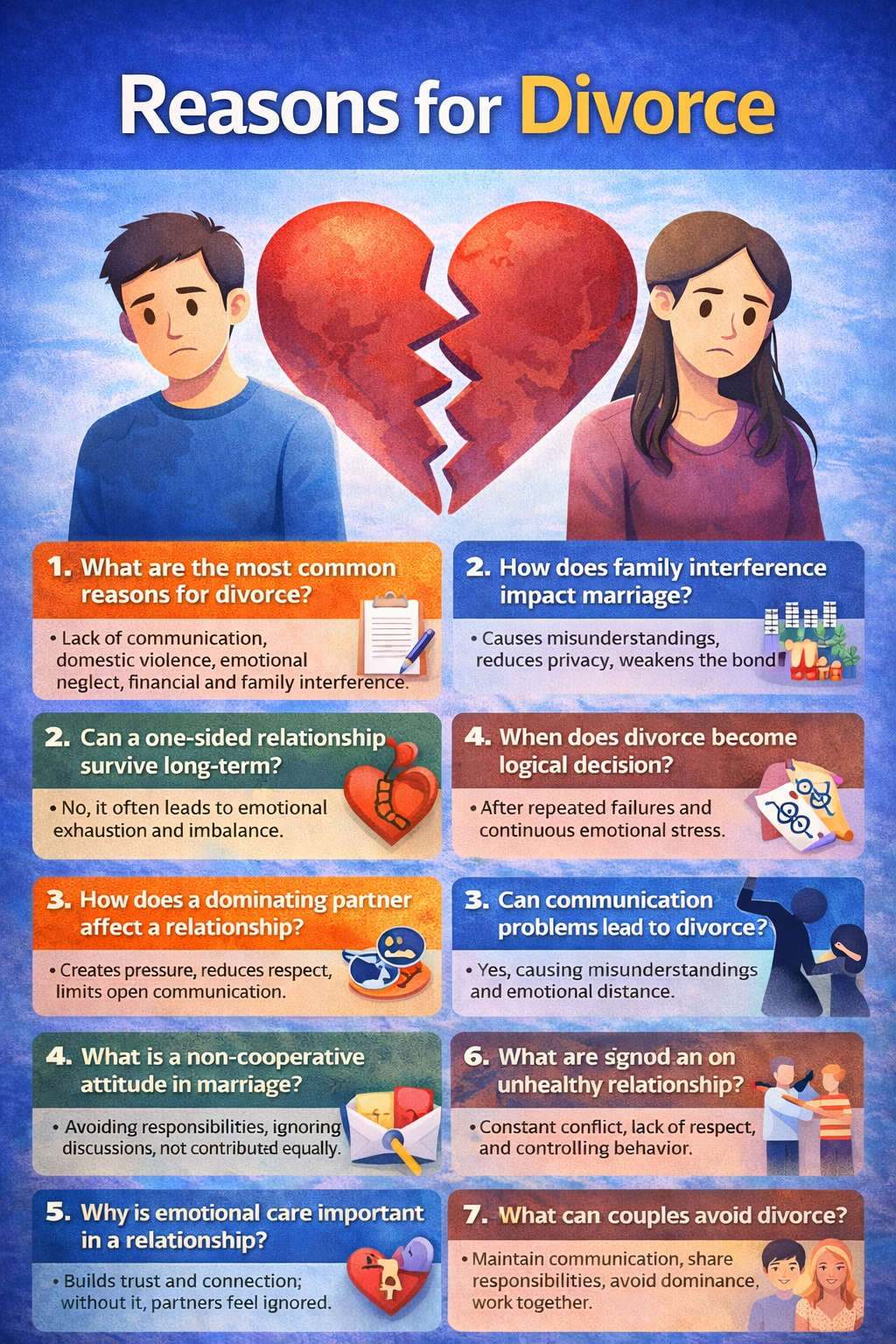
1. What are the most common reasons for divorce?
The most common reasons include lack of communication, domestic violence, emotional neglect, financial issues, non-cooperative behavior, and interference from family members.
2. Can a one-sided relationship survive long-term?
No, a one-sided relationship is difficult to sustain. When only one partner makes efforts, it eventually leads to emotional exhaustion and imbalance.
3. How does a dominating partner affect a relationship?
A dominating partner can create pressure, reduce mutual respect, and limit open communication, leading to frustration and emotional distance.
4. What is a non-cooperative attitude in marriage?
It refers to a partner who avoids responsibilities, ignores discussions, and does not contribute equally to maintaining the relationship.
5. Why is emotional care important in a relationship?
Emotional care builds trust, connection, and understanding. Without it, partners may feel ignored, leading to dissatisfaction.
6. How does family interference impact marriage?
Excessive involvement of family members can create misunderstandings, reduce privacy, and weaken the bond between partners.
7. When does divorce become a logical decision?
Divorce becomes logical when repeated efforts to fix the relationship fail and one partner experiences continuous emotional stress or imbalance.
8. Can communication problems lead to divorce?
Yes, poor communication can cause misunderstandings, unresolved conflicts, and emotional distance over time.
9. What are signs of an unhealthy relationship?
Signs include constant conflict, lack of respect, controlling behavior, emotional neglect, and absence of mutual effort.
10. How can couples avoid divorce?
By maintaining open communication, sharing responsibilities, respecting each other, avoiding dominance, and working together to resolve issues.