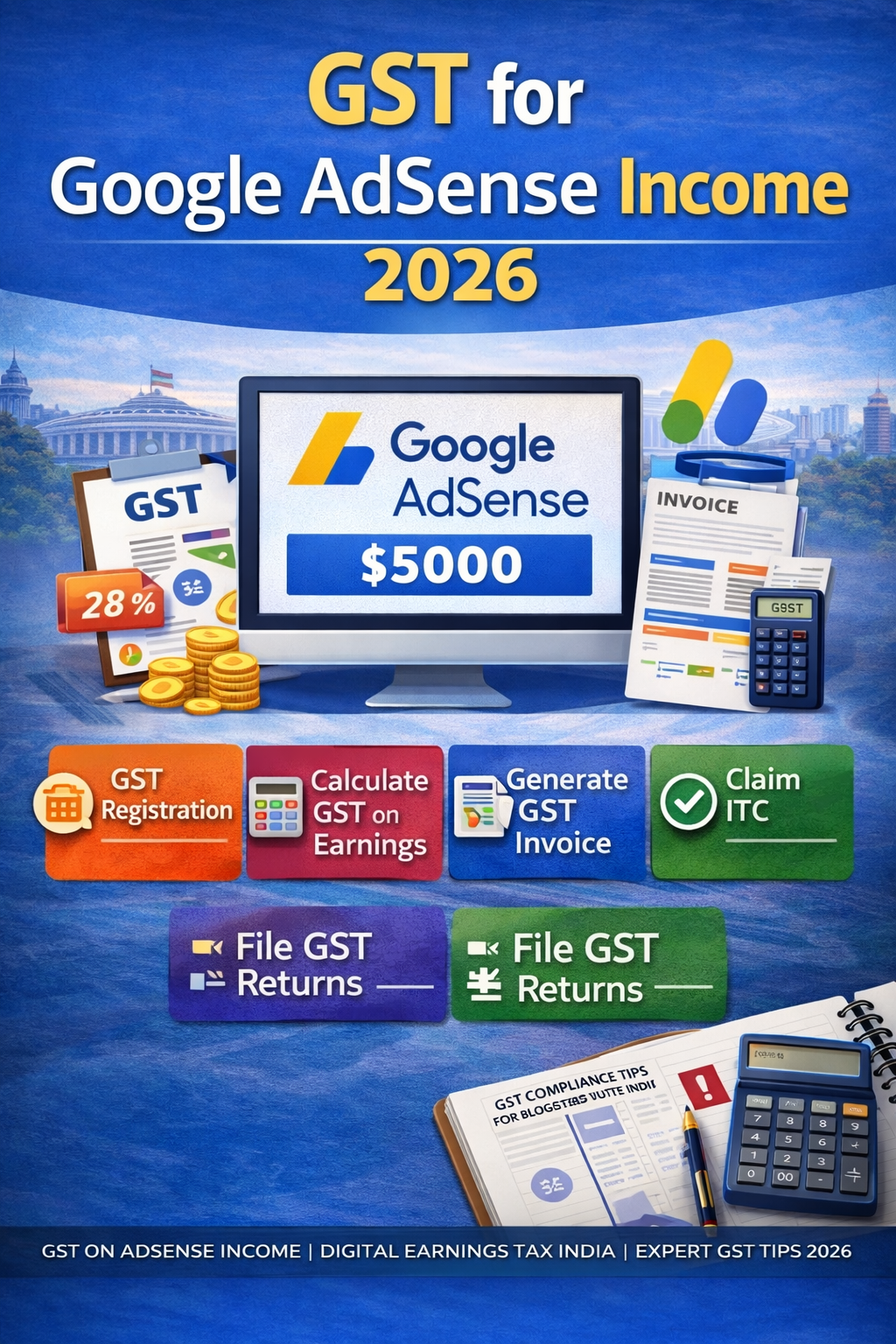
GST for Google AdSense Income 2026
Table of Contents
- Introduction to GST and Google AdSense
- GST Implications on Google AdSense Income
- Registration and Filing Requirements
- Tax Rates and Exemptions
- Case Studies and Examples
- Conclusion and Recommendations
Introduction to GST and Google AdSense
GST (Goods and Services Tax) is a tax levied on the supply of goods and services in India. Google AdSense is a program that allows website owners and content creators to earn money by displaying ads on their websites. The GST implications on Google AdSense income have been a topic of discussion among content creators and tax professionals. In this article, we will explore the GST implications on Google AdSense income in 2026.
GST Implications on Google AdSense Income
According to the GST laws, Google AdSense income is considered as an "export of services" since the payment is received from a foreign company (Google Asia Pacific Pte Ltd, Singapore). As per Section 2(6) of the IGST Act, 2017, this is classified as a zero-rated supply, which means that no GST is payable on the income. However, the content creator is still required to register for GST and file returns, even if the tax liability is zero.
Registration and Filing Requirements
Content creators earning Google AdSense income are required to register for GST if their annual turnover exceeds ₹20 lakhs (₹10 lakhs for special category states). They are also required to file monthly returns (GSTR-3B) and annual returns (GSTR-9). Additionally, they need to file a Letter of Undertaking (LUT) to export services without payment of GST.
Tax Rates and Exemptions
The GST rate on Google AdSense income is zero, as it is considered an export of services. However, the content creator may be required to pay income tax on the income earned. The income tax rate will depend on the individual's tax slab and other factors.
Case Studies and Examples
Let's consider an example of a content creator earning ₹45,000 per month from Google AdSense. The creator receives the payment from Google Singapore and does not charge GST. In this case, the creator is still required to register for GST and file returns, even if the tax liability is zero. Failure to comply with GST regulations may result in penalties and notices from the tax authorities.
Conclusion and Recommendations
In conclusion, GST implications on Google AdSense income in 2026 require content creators to register for GST and file returns, even if the tax liability is zero. It is essential to understand the GST laws and regulations to avoid penalties and notices from the tax authorities. We recommend that content creators consult with tax professionals to ensure compliance with GST regulations and to minimize their tax liability.
What is the GST rate on Google AdSense income?
The GST rate on Google AdSense income is zero, as it is considered an export of services.
Do I need to register for GST if I earn Google AdSense income?
Yes, you need to register for GST if your annual turnover exceeds ₹20 lakhs (₹10 lakhs for special category states), even if the tax liability is zero.
What are the filing requirements for Google AdSense income?
You need to file monthly returns (GSTR-3B) and annual returns (GSTR-9), and also file a Letter of Undertaking (LUT) to export services without payment of GST.
Can I claim input tax credit on Google AdSense income?
No, you cannot claim input tax credit on Google AdSense income, as it is considered an export of services and is zero-rated.
What are the consequences of not complying with GST regulations?
Failure to comply with GST regulations may result in penalties and notices from the tax authorities, and may also lead to bank account freezes and other consequences.
Frequently Asked Questions
What is the GST rate on Google AdSense income?
The GST rate on Google AdSense income is zero, as it is considered an export of services.
Do I need to register for GST if I earn Google AdSense income?
Yes, you need to register for GST if your annual turnover exceeds ₹20 lakhs (₹10 lakhs for special category states), even if the tax liability is zero.
What are the filing requirements for Google AdSense income?
You need to file monthly returns (GSTR-3B) and annual returns (GSTR-9), and also file a Letter of Undertaking (LUT) to export services without payment of GST.
Can I claim input tax credit on Google AdSense income?
No, you cannot claim input tax credit on Google AdSense income, as it is considered an export of services and is zero-rated.
What are the consequences of not complying with GST regulations?
Failure to comply with GST regulations may result in penalties and notices from the tax authorities, and may also lead to bank account freezes and other consequences.